



WHAT IS THE BELOVED TENOR?
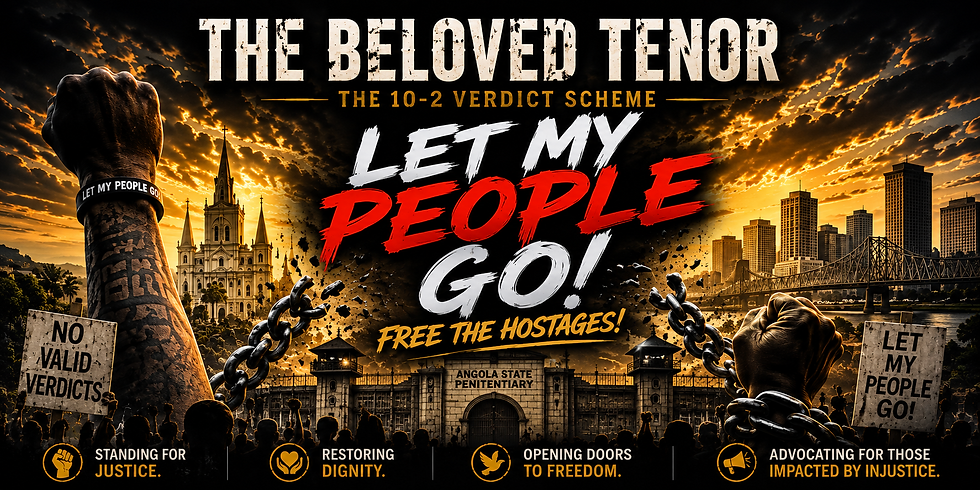
The Beloved Tenor is All The Way Right Ministry's name for the people and the cause connected to Louisiana's 10-2 non-unanimous jury verdict scheme.
"Beloved" represents the people - human beings who are more than a case number, conviction or prison record.
"Tenor" represents the 10-2 verdict at the center of this fight - the non-unanimous
verdict system that allowed a person to be convicted even when two jurors voted against guilt.
THEY ARE MORE THAN A VERDICT.
THEY ARE PEOPLE.
LET MY PEOPLE GO

THE HISTORY BEHIND THE 10-2
VERDICT SCHEME
1880 - THE LEGISLATIVE ACT
In 1880, Louisiana Legislature abandoned the traditional requirement of jury unanimity and authorized non-unanimous verdicts. Historical scholarship connects this change to the post-reconstruction convict -leasing era, when labor of incarcerated people - disproportionately Black - had enormous economic value.
1898 - THE RULE BECOMES CONSTITUTIONAL
Louisiana's 1898 Constitutional Convention established a 9 - 3 verdict rule for serious non-capital criminal cases. The convention openly declared that one of its purposes was to establish white supremacy, and the non-unanimous jury system diminished the power of Black jurors to prevent a convictions.
1974 - 9 - 3 BECOMES 10-2
Louisiana retained the non-unanimous system but changed the required vote from 9 of 12 to 10 of 12. Two jurors could disagree with guilt and a defendant could still be convicted.
1880 --1898 -- 10-2
THE NUMBERS CHANGED. THE DENIAL OF UNANIMITY REMAINED.

WHY THE BELOVED TENOR MATTERS
THE PEOPLE
Behind every verdict is a human being-a son, daughter, father, mother, brother or sister. The Beloved Tenor recognizes the people whose lives and families were affected by Louisiana's non-unanimous jury system.
THE VERDICT
For generations, Louisiana permitted felony convictions even when one or two jurors voted against guilt. In Ramos v. Louisiana, the U.S. Supreme Court held that the Sixth Amendment requires unanimity to convict a defendant of a serious offense in state court.
THE UNFINISHED FIGHT
Ramos ended the use of non-unanimous verdicts going forward, but it did not automatically provide federal collateral relief to every person whose conviction had already become final. That is why the consequences of Louisiana's former system remain part of the fight today.
THE LAW CHANGED
THE PEOPLE REMAIN
LET MY PEOPLE GO.

THE FIGHT TODAY
RAMOS CHANGED THE LAW - BUT NOT THE PAST
In 2020, the U.S. Supreme Court held in Ramos v. Louisiana that the Sixth Amendment requires a unanimous verdict to convict a defendant of a serious offense in state court. Louisiana could no longer use a 10-2 verdict to obtain a convictions.
THE PEOPLE LEFT BEHIND
Ramos ended Louisiana's use of non-unanimous verdicts going forward, but did not automatically overturn every conviction that was already final. In 2021, the U.S. Supreme Court held in Edwards v. Vannoy that the Ramos rule does not apply retroactively in federal collateral review. That left many people convicted under Louisiana's former system still fighting for relief.
ATWRM'S POSITION
ATWRM raises a new constitutional challenge: Louisiana's non-unanimous jury provisions deprived defendants—disproportionately Black defendants—of the mistrial we contend should have followed when a jury failed to reach the constitutionally required unanimous verdict.
Our Bill of Attainder argument contends that the Legislature could not substitute its enactment for the constitutional safeguards of a judicial trial and authorize punishment where no constitutionally valid jury verdict existed.
THE MISTRIAL MATTERS
A mistrial would have triggered Louisiana's laws governing retrial. Under La. C.Cr.P. art. 582, a second trial generally must begin within one year of the mistrial order or within the Article 578 period, whichever is longer, subject to the applicable interruption and suspension provisions.
ATWRM argues that the State cannot benefit from legislation that deprived defendants of the mistrial and the protections that would have followed it.
THE PRECEDENT WE SEEK
This is the constitutional question ATWRM is bringing forward:
Could the Legislature take away the mistrial, substitute a non-unanimous vote for the constitutionally required verdict, and impose punishment without a constitutionally valid judicial trial?
ATWRM'S POSITION: NO.
THE MISTRIAL WAS DENIED.
THE SAFEGUARDS WERE DENIED.
FREE THE PERPETUAL PRETRIAL DETAINEES.
LET MY PEOPLE GO.
f

WHO ARE THE BELOVED TENOR?
THE MEN AND WOMEN BEHIND THE VERDICTS
The Beloved Tenor are the men and women whose lives were forever changed by Louisiana's non-unanimous jury system. They are fathers and mothers, sons and daughters, brothers and sisters. They are not case numbers. They are not statistics. They are people.
THE ONES LEFT BEHIND
When the law changed, many remained behind prison walls. Families continued growing older. Children grew into adults. Parents and grandparents passed away. Years became decades while men and women continued living under convictions produced by a system Louisiana can no longer use to convict anyone today.
WHY WE CALL THEM BELOVED
We call them Beloved because their humanity comes before their conviction. We refuse to allow a verdict, a prison number, or a passage of time to erase their value. They are still somebody's family. They are still part of our communities. They still matter.
WHY "TENOR"?
The Tenor represents the voice carried through this movement-the voices of those behind the walls and the families who refuse to forget them. ATWRM intends to carry those voices where they cannot carry themselves.
THEY HAVE NAMES.
THEY HAVE FAMILIES.
THEY HAVE VOICES.
THEY ARE THE BELOVED TENOR.

THE FIGHT CONTINUES
THE LAW CHANGED. THE PEOPLE REMAIN
The Beloved Tenor are more than the history of Louisiana's non-unanimous jury system. They are men and women who remain separated from their families and communities while the fight for justice continues.
All The Way Right Ministry stands with those left behind. We will continue raising their voices, challenging injustice, building public support, and fighting for meaningful relief.
THIS FIGHT IS ABOUT PEOPLE.
THIS FIGHT IS ABOUT FAMILIES.
THIS FIGHT IS ABOUT FREEDOM.
THEY HAVE NOT BEEN FORGOTTEN.
LET MY PEOPLE GO.